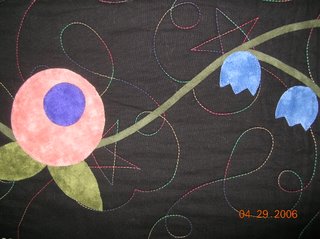
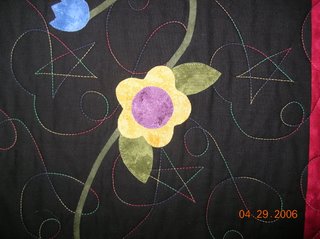
The most interesting "piece" wasn't a quilt, but drew a lot of attention none the less. The entire piece was fabric - watering can and flowers. The water streaming from the watering can was made from beads.


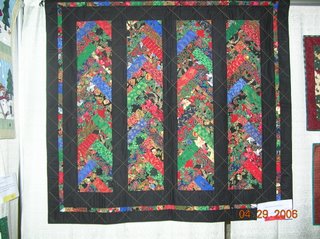
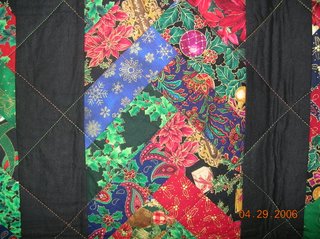
This quilt would be great for using up leftover strips. The story that went with this quilt indicated that the scraps were cut 2 1/2" x 4 1/2" and then traded with three other ladies. All the scraps were then stuck in a bag and pulled out randomly and sewn together.
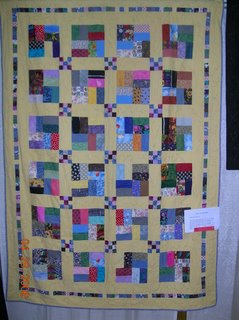
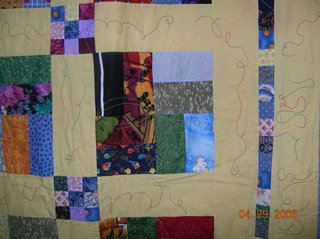
This quilt was a chevron which is great for using up scrap strips as well. The thing that really interested me about this one was the choice of quilting design used to finish it off. The quilting gives an optical illusion quality or secondary design to this quilt.
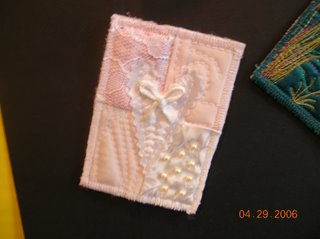 I copied the following information from the poster that was on display next to the ATCs.
"Swiss performance artist M. Vanci Stirnemann was the originator of the Artist Trading Card (ATC) phenomenon. On a visit to Canada for the Calgary Olympic Arts Festival in 1988 he noticed people swapping hockey cards. Nearly a decade later he made 1000 miniature works of art the same size as hockey cards and in April 1997 he displayed them in a Swiss book shop. Visitors asked if they could buy them but instead Stirnemann asked them to make their own cards and bring them in to swap".
Searching the internet, I found the following links about ATCs:
http://www.joycehartley.com/atcs.htm - Pictures of Joyce Hartley's Artist Trading Cards
http://www.artchixstudio.com/create/classroom/class_fabricatc.htm - Instructions on how to make your own Artist Trading Cards
http://cqmagonline.com/vol03iss02/articles/art258/index.shtml - An interesting article on ATCs
http://prettyimpressivestuff.com/blog/2006/04/fiber-artist-trading-cards.html - Blog reference to ATCs
I can hardly wait to try making some myself.